enfin aujourd'hui ce qui ne fut alors


Nurse With Wound/ Cyclobe – “Root Canal Splinter (Penetration mix)” (Angry Eelectric Finger (Spitch'cock One)) 2004

Shim Sang-gun – “Chinhyangjo” (Kayagum Sanjo) Anos 30
Shim Sang-gun – “Chung jung mori (1)” (Kayagum Sanjo) 1927

Michio Miyagi – “Sakura Henso-Kyaku” (Masterpieces of Koto by M. Miyagi) 1957

Sato Chiyako – “Haha no uta” ? 1930
The Residents (w/ Snakefinger) – “Sinister Exaggerator” (Duck Stab) 1978
Costin Miereanau – “Parte seconda (prima)” (Luna Cinese) 1975

Doo-Dooettes – “(Twenty four)” (Live at the Brand) 1976

Anal Magic & the Rev. Dwight Frizzell – “O what joy it is to know you have a turtle heart” + "Pre-Transformation of Turtle to Bird" (Beyond the Black Crack) 1976
Brainticket – “Radagacuca” (Psychonaut) 1972
Surprieze – “Lazarus” (
Zeer Oude Klanken en Heel Nieuwe Geluiden) 1973
Gamelan GongSekar Anjar and Gendèr Wajang – “Sekar Sungsang” (The Exotic Sounds of Bali) s/d
Ghédalia Tazartès – “Rien qu’au soleil” (Diasporas & Tazartès) 1977-80’
s
Maschine nº9 – “Titel 1” (Headmovie) 1974)


moebius river bands


The Möbius Band is the building block for non-orientable surfaces. It is formed by joining the ends of a rectangle with a twist (180 degrees). Any non-orientable surface contains a Möbius Band, and any surface which contains a Möbius Band is necessarily non-orientable. It is not closed--hence it is not a surface, and it contains one boundary curve. The Möbius Band cannot be embedded in the plane, R^2.


Thames & Hudson, Lockwood & Haendel, lado a lado, vertidos e invertidos, para a frente e para trás, duas vezes dois canais numa só banda. (ver 21.01.07)

sem título #1/2


Semi-composição com sons de Tsutsumi Katsuki, The Ewlis Mason Quintet, Gilles Gobeil, Baiyon, Nurse With Wound, Borat, Coil, Gulpass, Bernard Parmegiani, Glen Gould (Bach), Skip James, Yves Daoust para dois laptops misturados no Estúdio 3.


I am silver and exact. I have no preconceptions.
Whatever I see I swallow immediately
Just as it is, unmisted by love or dislike.
I am not cruel, only truthful-
The eye of the little god, four cornered.
Most of the time I meditate on the opposite wall.
It is pink, with speckles. I have looked at it so long
I think it is a part of my heart. But it flickers.
Faces and darkness separate us over and over.
Now I am a lake. A woman bends over me,
Searching my reaches for what she really is.
Then she turns to those liars, the candles or the moon.
I see her back, and reflect it faithfully.
She rewards me with tears and an agitation of hands.
I am important to her. She comes and goes.
Each morning it is her face that replaces the darkness.
In me she has drowned a young girl, and in me an old woman
Rises toward her day after day, like a terrible fish.

(Sylvia Plath, Mirror)

1982


Ever see one of these before, mister? Yes, you. I'm talking to you, ma'am. Ever work one of these Commodores or Timex Sinclairs or Osborne Is or TRS-80 IIIs? How do you like them Apples? Just a joke, son. Good, clean fun. But you look so skeptical, like you're from Missouri, and I want to sell you one of these beauties, 'cause you need it and 'cause you want it, no matter what you say. Deep in your all-American heart (you are American, aren't you, pal?), you crave this little honey, which will count for you and store for you and talk for you, and one day it might even kiss for you (no offense, miss). Point is, it will save you time. Time time time. And we need all the time we can save. Can't kill time without injuring eternity. Thoreau said that. Great American, Thoreau.
Roger Rosenblatt

No dia 18 de Março de 2007 o programa foi realizado utilizando apenas sons de 1982

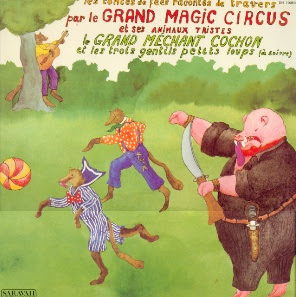
le grand méchant cochon et les trois gentils petits loups


'L'histoire, que vous savez, est racontée et mise en musique dans une nouvelle saga pleine de blagues et de connivences avec l'enfant qui écoute. Aucun n'y résistera, c'est vraiment très drôle'

Jerôme Savary

Né en Argentine en 1942, son père était écrivain et sa mère la fille de Frank Higgins, Gouverneur de l’Etat de New York. Sa mère revient en France en 1947 et sa famille s’installe en Haute-Loire où Jérôme Savary poursuit sa scolarité au Collège Cévenol.

Très jeune, il part pour Paris où il étudie la musique avec Les Martenots, avec l’ambition de devenir musicien de jazz. En 1958, il entre à l’Ecole des Arts Décoratifs. A 19 ans il part pour New York où il s’immerge dans le monde du jazz et rencontre Lenny Bruce, Count Basie et Thelonious Monk.

Quand il revient en France, il intègre le monde du théâtre et les « argentins de Paris » parmi lesquels : Jorge Lavelli, Copi et Fernando Arrabal. En 1965, il fonde sa première compagnie théâtrale : la Compagnie Jérôme Savary, qui sera ensuite appelée le Grand Magic Circus, avant de devenir en 1968 le Grand Magic Circus et ses animaux tristes.

De 1982 à 1985 il est directeur du Centre Dramatique National du Languedoc-Roussillon à Béziers et Montpellier. Il est nommé par le ministre de la Culture et par la ville de Lyon directeur du Carrefour Européen du Théâtre - Théâtre du 8e de 1986 à 1988.

En 1988 il est nommé Directeur du Théâtre National de Chaillot, poste qu’il occupera jusqu’à sa nomination à l’Opéra Comique le 1er octobre 2000. (in: ThêatreOnline)

Grand Magic Circus - Le Grand Méchant Cochon et les Trois Gentils Petits Loups (1974)

Anton Bruhin - In/Out (In/Out) 1981

INOUT was recorded on a Sanyo M7300L stereo radio cassette recorder with both an integrated and external microphone.

The recorder is in the recording standby position, both RECORD and PAUSE buttons are pushed. Then I sing or play a tone into the microphone. During this tone, I release the PAUSE button by pushing it. Subsequently, I press the PAUSE button again within a fraction of a second. Now the first short note is recorded. In InOut I added this way thousands of very short notes like
a patchwork, like an acoustic quilt with geometric irregularities and varied patterns.

The percussive effect was produced by the clicking noise of the PAUSE button. Recorded with the integrated microphone, those clickings appear with pretty high amplitude, depending on the vehemence by which I pushed the button. Recorded with the external microphone, the clicking will not be recorded and remain silent on tape. For InOut I alternated both possibilities; for a longer passage I recorded solely clicking noises to obtain a percussion solo. (in:
ubuweb)

evp - electronic voice phenomenon


Electronic voice phenomena (EVP) é uma expressão cunhada pela editora Colin Smythe Ltd. para descrever sons de fala humana ou próximos da fala humana, supostamente de origem paranormal, que ocorrem em meios de gravação não usados préviamente.
Tais sons foram previamente denominados "Vozes de Raudive", pelo próprio
Konstantin Raudive, um estudante de Carl Jung, professor da Universidade de Upsalla, na Suécia, que estudou durante toda a sua vida sobretudo fenómenos de parapsicologia, nomeadamente os ligados à vida depois da morte. Foi pois um dos primeiros a estudar este tipo de fenómenos, ao lado do alemão Hans Bender. Raudive escreveu um livro famoso sobre este tema, chamado "Breakthrough: An amazing experiment in electronic communication with the dead" e editado em 1971. Esse disco era acompanhado por um flexi-disc, com alguns registos daquele fenómeno e com a respectiva descrição.
O programa de hoje foi construído a partir desse flexi-disc.

Mais informação na
WFMU


Konstantin Raudive - Breakthrough: An Amazing experiment in electronic communication with the dead (1971)
ELpH vs. Coil - Worship the glitch (1995)
Alva Noto - Transform (2001)
Ryoji Ikeda - Time and Space (2000)
Ryoji Ikeda - op. (2002)

acoustic design

O programa de hoje baseou-se num projecto canadiano de acústica ambiental - The vancouver soundscape (1973) - que explora, desde os anos 70, o som dos espaços urbanos de Vancouver. No entanto, a inspiração levou-nos a misturar os sons desta viagem acústica urbana com o som de outros "arquitectos" sonoplastas, entre os quais Basil Kirchin, Conrad Schnitzler e os japoneses Tolerance.

"Acoustic design is described by the WSP [World Soundscape Project] as the practical, applied component of soundscape studies. It is considered as necessary in order to deal with the growing complexity and the unbalancing of the modern soundscape, which cannot be solved ‘naturally’. In t
he conclusion of the Five Village Soundscapes (1977), Schafer presents acoustic design as a discipline “which will concern itself with techniques for the analysis and improvement of existing soundscapes and the creation of new ones” " (Describing the contemporary sound environment+)

The World Soundscape Project (WSP) was established as an educational and research group by R. Murray Schafer at Simon Fraser University during the late 1960s and early 1970s. It grew out of Schafer's initial attempt to draw attention to the sonic environment through a course in noise pollution, as well as from his personal distaste for the more raucous aspects of Vancouver's rapidly changing soundscape. This work resulted in two small educational booklets, The New Soundscape and The Book of Noise, plus a compendium of Canadian noise bylaws. However, the negative approach that noise pollution inevitably fosters suggested that a more positive approach had to be found, the first attempt being an extended essay by Schafer (in 1973) called 'The Music of the Environment,' in which he describes examples of acoustic design, good and bad, drawing largely on examples from literature.

"Combining the gentlest of the urban projects, a 1973 survey of Vancouver's soundscape, with the most stylistically varied, a 1996 reprise of the project, this two disc set is a great place to begin tuning your ears toward human soundscapes. The first disc, recorded and released during acoustic ecology's birth in British Columbia, is a loving portrait of city soundmarks. Each track focuses on a certain element of the city's voice: the harbor ambience, the music of horns and whistles, park sounds, etc.; there is no chaos or sense of overwhelm here, but rather a celebration of the sonic beauties and comforts found in daily city sounds. Perhaps this disc is a relic of bygone days, when even cities were a bit more hospitable to our ears and souls." (Earth Ear+)

Fragmentos de:
Basil Kirchin+ - Worlds within worlds (1974)
Conrad Schnitzler+ - Gelb (1974/1981)
Conrad Schnitzler - Rot (1973)
Tolerance+ - Divin (1981)

[dica: se clicardes por cima dos nomes de artistas ou bandas, encontrareis alguma informação adicional!]

erinnerungen, träume, gedanken


Carl G. Jung (1875-1961)


Na primavera de 1957, com a idade de 81 anos, C. G. Jung tomou a iniciativa de escrever a narrativa da sua vida e obra. Regularmente, tinha conversas com a sua amiga e colega Aniela Jaffe, colaborando com ela na preparação do texto baseado nessas conversas. Por vezes, ele mesmo escreveu de sua mão capítulos inteiros do livro, e continuou a trabalhar nas fases finais do manuscrito até quase à data da sua morte, em 6 de Junho de 1961. O programa de hoje foi baseado em leituras desse livro: Memories, Dreams, reflections.

Fragmentos de Bill Laswell & Terre Thaemlitz (Web), Redux Creative (live), Máquina Preservadora (Neil Jung Rendered), Henry Purcell (King Arthur), Mika Vainio (Kantamoinen), Wolf Eyes (Slicer), Oval (Systemisch), NWW (Ladies Home Tickler), Kazumoto Endo (Brick and Mortar)...

vozes em órbita

«on February 20, 1962 at 9:47:39 am EST, John Glenn rode Friendship 7 from Cape Canaveral's Launch Complex 14 to become an American hero. Over the Indian Ocean on his first orbit, Glenn became the first American to witness the sunset from above 100 miles. Awed but not poetically inclined, he described "this moment of twilight is simply beautiful. The sky in space is very black, with a thin band of blue along the horizon." On the nightside of Earth, nearing the Australian coastline, Glenn made his planned star, weather, and landmark observations. Within voice radio range of the Muchea, Australia, tracking station, Glenn and Gordon Cooper began a long space-to-Earth conversation. The astronaut reported that he felt fine, that he had no problems, and that he could see a very bright light and what appeared to be the outline of a city. Cooper answered that he probably saw the lights of Perth and Rockingham. Glenn also said that he could see stars as he looked down toward the "real" horizon - as distinguished from the haze layer he estimated to be about seven or eight degrees above the horizon on the nightside - and clouds reflecting the moonlight. "That sure was a short day," he excitedly told Cooper. "That was about the shortest day I've ever run into."» (1st american in orbit: John Glenn @ The Ultimate Space Place)


"1975 saw the release of Kosugi's best solo recording, Catch Wave. This features on one side "an excerpt from a meta-media solo improvisation" utilising heavily-processed violin, voice, radio and oscillators (the latter modified via wind and light) to create a massive drone piece. Side two is "a triple performance by a solo vocalist" where a vocal phrase is taken and electronically modified until it loses any meaning other than as part of the wave form. This LP represented a continuation of his interest in the heterodyne phenomenon, where alternating currents of different frequencies combined to produce new frequencies, the sum and difference of the original frequencies. This was something he had worked with on earlier recordings and continued to be important through later works."(in: Noise:NZ/JAPAN)
Em 1997, Takehisa Kosugi re-interpretou esta obra com a performance "Catch-Wave '97".


"Voices, language and space… they interested me even in the early 60s when I wrote The Emperor of Ice Cream for the ONCE Festivals in Ann Arbor. Since each of us knows so much about the behavior of the voice - intimate endearments, rage at a distance - it is an ideal vehicle for auditory spatial illusions (all the more when in the service of language and its powers of invocation). In the early 70s, at the Center for Music Experiment in La Jolla, I heard daily rehearsals of the Extended Vocal Techniques Ensemble as they perturbed vocal norms. Evenings, I read my daughter to sleep trying to capture, for each character in the story, an individual and consistent vocal behavior. She was a demanding critic, and stimulated a good deal of nocturnal reflection about vocal identity. Electronics, at first analogue, later digital systems, offered rather precise control over auditory space (a particular sound’s size, location, distance, the character of the host space in which it was heard). I sought spare but evocative texts and tried to conjure up unfamiliar yet appropriate vocal behaviors with which to present them. The five works in the series thus far share a concern with the potential of auditory spatial imaging: this is a subject still only tentatively broached. They attempt to create a personal theater through the mind’s ear. Yet they are distinct. Three of them are presented here." (Roger Reynolds about Voice Space)


Takehisa Kosugi - Mano Dharma '74 + Wave code #e-1 (Catch-Wave) 1975 (re-editado em 2002)
John Glenn - America's first man in orbit, 7'', lados A e B, narração de Lt. Col. John Powers, 1962
Roger Reynolds - Still (Voicespace I) 1975 + The Palace (Voicespace IV) 1980, barítono Philip Larson

thames & hudson

"This is an aural journey from the source of the river, Lake Tear of the Clouds in the high peak area of the Adirondacks, downstream to the Lower Bay and the Atlantic. The work was originally commissioned by the Hudson River Museum, Yonkers, NY, as an installation.Since 1970 I have recorded rivers in many countries, not to document them, but rather for the special state of mind and body which the sounds of moving water create when one listens intently to the complex mesh of rhythms and pitches. Each stretch of the Hudson has its own sonic texture, formed by the terrain, varying according to the weather, the season and, downstream, the human environment whose sounds are intimately woven into the river's sounds." (Annea Lockwood)

Annea Lockwood - A Sound Map of the Hudson River (1982)
George Frideric Handel - Water Music suite nº1, 2 & 3 (circa 1715-1
717), interpretado por Academy of St-Martin-in-the-Fields, dir. Sir Neville Marriner


"At about 8, the King took Water at Whitehall in an open Barge ... and went up the [Thames] River towards Chelsea. Many other Barges with Persons of Quality attended, and so great a Number of Boats, that the whole River in a manner was cover'd; a City Company's Barge was employ'd for the Musick, wherein were 50 instruments of all sorts, who play'd all the Way from Lambeth the finest Symphonies, compos'd express for this Occasion, by Mr. Hendel; which his Majesty liked so well, that he caus'd it to be plaid over three times in going and returning. At Eleven his Majesty went a-shore at Chelsea where a Supper was prepar'd, and then there was another very fine Consort of Musick, which lasted till 2; after which, his Majesty came again into his Barge, and return'd the same Way, the Musick continuing to play till he landed."
[in: The Daily Courant, April 17, 1717]

jhonn balance (16th Feb 1962 - 13th Nov 2004)


Wise words from the departing:
eat your greens especially broccoli...
always wear sensible shoes
and remember to say
please and thank you,
especially for the things
you never had...

Coil

"Ascension" (The Angelic Conversation) "Red Birds Will Fly Out of the East and Destroy Paris at Night" (Musick to Play in the Dark Vol.1) "Higher Beings Command" (Constant Shallowness Leads to Evil") "Egyptian Basses" (Backwards Demos) "Stoned Circular II" (Black Light District) "Remote Viewing 3" (The Remote Viewer) "An Apology" (Unnatural History IV) "Windowpane (razormaid mix)" (Unnatural History IV) "Things We Never Had" (Black Antlers) "Queens of the Circulating Library" (Coil Live One) "Remote Viewing 4" (The Remote Viewer) "Constant Shallowness Leads to Evil" (Coil Live Two) "Going Up" (The Ape of Naples)

guia estéreo para cristais, radiofonias e anfíbios

" Crystal sound therapy is a system in which sound is generated from crystals to therapeutic effect. This process uses highly tuned electromagnetic waves to excite individual crystals so that they emit audible sound waves; each crystal has an individual note at which it resonates, that is vibrates and gives off sound energy." Harry Oldfield

Harry Oldfield - Energy is Eternal Delight ("Crystal") 1990
La Monte Young - Drift Study (Theatre of Eternal Music) 1973
Christian Marty & Philippe Gaucher - Bufo Granulosus, Epipedobates Femoralis, Scinax Proboscideus, Hyla Brevifrons (Guide sonore des amphibiens de Guyane) 1999
MIlan Stibilj - Rainbow (Eletronic 2000 - Philips) 1970
George W. Bush - The night before christmas 2006
Yves Daoust - Fantaisie (Musiques Naïves) 1986
Test Department - Nadka (Terra Firma) 1988
Roger Reynolds - Eclipse: voicespace III (Voicespace) 1992
Andrew Liles - The Presbytery has lost Nothing of its Charms nor the Garden its Brightness (Mother goose's melody or sonnets for the cradle) 2005
Culturcide - Depressed Christmas


glückwunsch


A 20 de Maio de 2006 a equipa do tecnosterona actuou numa festa de aniversário e hoje tornou pública essa performance.

fingered


"Walking women want to see the southern cross at night
And so they set aside a sock, and tie their laces tight
Yes mournful is the melody that echoes in their heads
Without a beat they march along, believing Bach is dead"
The Residents, Duck Stab, 1978


o que foi:

Nurse With Wound/ Cyclobe – “Root Canal Splinter (Penetration mix)” (Angry Eelectric Finger (Spitch'cock One)) 2004
Shim Sang-gun – “Chinhyangjo” (Kayagum Sanjo) Anos 30
Shim Sang-gun – “Chung jung mori (1)” (Kayagum Sanjo) 1927
Michio Miyagi – “Sakura Henso-Kyaku” (Masterpieces of Koto by M. Miyagi) 1957

Sato Chiyako – “Haha no uta” ? 1930
The Residents (w/ Snakefinger) – “Sinister Exaggerator” (Duck Stab) 1978
Costin Miereanau – “Parte seconda (prima)” (Luna Cinese) 1975

Doo-Dooettes – “(Twenty four)” (Live at the Brand) 1976

Anal Magic & the Rev. Dwight Frizzell – “O what joy it is to know you have a turtle heart” + "Pre-Transformation of Turtle to Bird" (Beyond the Black Crack) 1976
Brainticket – “Radagacuca” (Psychonaut) 1972
Surprieze – “Lazarus” (
Zeer Oude Klanken en Heel Nieuwe Geluiden) 1973


(o que não foi:
Gamelan GongSekar Anjar and Gendèr Wajang – “Sekar Sungsang” (The Exotic Sounds of
Bali) s/d

Ghédalia Tazartès – “Rien qu’au soleil” (Diasporas & Tazartès) 1977-80’
s
Maschine nº9 – “Titel 1” (Headmovie) 1974)


la mystérieuse nuit A(d)vent Bach


"La première oreille a tout divisé
La deuxième oreille a tout multiplié
La troisième oreille a tout unifié"

Otto von Schirach – “Trick Snitch” (Maxipad Detention) 2006
Venetian Snares – “Cadmium Lung Jacket” (Huge Chrome Cylinder Box Unfolding) 2004
Otto von Schirach – “The Seventh Juggler” (Maxipad Detention) 2006
Wolf Eyes – “4 untitled track” (Slicer) 2002
Man is The Bastard – “Denied Psychotic Human pt.2” (Throne is Melting) 2002
Nord – “Entract” (Nord) 1981
Maurizio Bianchi – “Accop (6) Ethe” (Symphony for a Genocide) 1981(1998CD)
D.A.F. – “Der Räuber und der Prinz” (Alles ist Gut) 1981
Gorilla Aktiv – “Umsonst Ohne Risiko/Suono Seguito” (Umsonst Ohne Risiko) 1982
Otto von Schirach – “La Sangre del Dedo Intelecto” (Global Speaker Fisting) 2004
Otto von Schirach – “Fractal Nut Vinigerette” (Global Speaker Fisting) 2004
Célomalabit – “Tikiki” 2006?
Luc Ferrari – “Presque Rien n.2 side A” (Presque Rien) 1980
L’infonie – “Concerto en Ré Mineur (Allegro)” (Vol. 333) 1972

two shaves and a shine

A reedição do disco "An Awkward Pause" dos Nurse With Wound, em duplo CD, traz uma pequena surpresa: uma faixa de aproximadamente 2 minutos, intitulada "Two Shaves and a Shine (Ingredients) Create your own track!".
No dia 25 de Novembro, a emissão do vosso programa de rádio favorito foi inteiramente cozinhada utilizando apenas esses mesmos ingredientes.

Two Shaves and a Shine remix contest!
As most of you know, disc 2 of our 'An Awkward Pause' reissue contains a track entitled 'Two Shaves and a Shine (Ingredients) Create your own track!'. We've decided to take that literally and have a contest which will allow you, the listener, to create your own version of 'Two Shaves' and submit it to us.All completed tracks will be uploaded by you to the site at
http://www.jnanarecords.com/newsf.html and passed on to Steven. After the competition is closed (December 31, 2006), Steven will choose his favorites, with one entry being selected as the winner.At that point, we will post the Fave 10 on the site and allow you to download both the tracks and custom artwork (designed by Steven), to make your own CD of Steven's favorites. The winner will receive the original piece of Steven's art which was used to form the basis of the CD cover.The discs will be in stock in the last week of October. Allowing for possible delays and mailing time as well, it should still leave a good 4–6 weeks for you to create your masterpiece! RulesAll tracks must include some portion of each element of 'Two Shaves and a Shine' as released on 'An Awkward Pause'. All tracks are to be no longer than 5 minutes. All tracks are to be uploaded in MP3 format, with a bit rate of 128 kbps and a sample rate of 44.100 kHz. You can, if you wish, give your track a title and specify an artist/band name for yourself (you can of course use your real name). This information can be supplied on the upload form. It is recommended that you name your MP3 file so that it includes your real name and/or track title, to make identification easier for us at this end. Tracks must be uploaded to the site by 11:59 pm (US PST) December 31, 2006. Contest winners will be announced by March 31, 2007. A valid email address must be included. By uploading a track you are consenting to allow the track to be made available for free download and copying from www.jnanarecords.com should your track be chosen as one of Steven's Top 10.

máquina preservadora FNAC

A emissão do dia 21 de Outubro tem como pano de fundo o concerto de Máquina Preservadora, gravado no mesmo dia, no espaço FNAC em Coimbra.


A "
Máquina Preservadora" [inspiração num conto de Philip K. Dick] é um processo viral que subverte a intenção inicial de conservar a obra de arte musical num organismo animal. Uma obra de arte não pode ser conservada, mas apenas corrompida e transformada pelo Tempo que ela própria abre. O animal é uma estrutura maquinal, mas viscosa, fluida, instável, e nunca simplesmente mecânica, pelo que baralha as regras da causalidade eficiente e tende a fugir aos mecanismos do Império da Prisão de Ferro Negro. "Máquina Preservadora" é, então, o vírus que corrompe e modifica, o movimento delirante num colete-de-forças, a inversão da matemática criativa que desmultiplica o 3 do 1 em Pi, o lapso, a falha, o hiato de som a que chamamos ruído, o bip de um desfibrilador num troço de auto-estrada.

Máquina Preservadora (parte I)
Throbbing Gristle, "Dream Machine"
Pan Sonic & Alan Vega, "Endless" (Endless)
Máquina Presevadora (parte II)
Akira Rabelais, "Gymnopedie No.1" (Eisotrophobia)
Alva Noto, "Autoshape" (Transspray)

destruidores de civilizações e ondas radiofónicas (7 de Outubro)


EMISSÃO INDUSTRIAL PARA OUVINTES INDUSTRIAIS

Throbbing Gristle - "X-Ray" (TG Now)
Throbbing Gristle - "Primal Church / Look Away / Endless Discipline"(Once Upon a Time)
Psychic TV - "Opium" (Pagan Day)
Psychic TV - "Unclean" (Descending)
William S. Burroughs - "Naked Lunch"
Merzbow & Genesis P-Orridge - "All Beauty Is Our Enemy" (A Perfect Pain)
Throbbing Gristle - "Industrial Introduction" (The Taste Of TG)
---------------------------------------------------------------------------------
Virgin Prunes - "Rhetoric" (Sons Find Devils)
Non - "Total War" (In The Shadow Of The Sword)
Throbbing Gristle - "10 Pence" (Very Friendly)
Nightmare Lodge - "The Lift" (V/A - Sound From Hands)
Throbbing Gristle - "Splitting Sky" (TG Now)
Coil - "Sex With Sun Ra" (Black Antlers)
Zoviet-France: - "Norsch Baelmaen" (Norsch)
Throbbing Gristle - "20 Jazz Funk Greats" (20 Jazz Funk Greats)
Throbbing Gristle - "United" (The Taste Of TG)
Chris Carter - "Solidit" (V/A - Tyranny Of The Beat)
Merzbow & Genesis P-Orridge - "A Perfect Restraint" (A Perfect Pain)
Coil - "Enochian Calling" (The Angelic Conversation)

off-topic #001

ENCONTROS de MÚSICA EXPERIMENTAL
O Velho e o Novo // The old and the new
sons e imagens de 2006 num templo de 1470

O u t u b r o , 4 - 7 | 2 2 h
bilhetes à venda no local, a partir das 21 horas

Concertos:
Outubro, 4
Micro Audio Waves (P)
Harald Sack Ziegler (D)
00:30h - Bar ADN [ EMEout ]
Internal Sync (Manuel Calapez, Remix Filipe)

Outubro, 5
Húmus (P)
Murcof (MX / ES)

Outubro, 6
One Might Add (P)
Oval (D)

Outubro, 7
Collen (UK)
Naja Orchestra + Colleen (P+UK)

Conversas com Artistas:
António Jorge Gonçalves - 4 de Outubro, 10:00h

Instalações :
Paulo Mendes, António Jorge Gonçalves, Edgar Santinhos, Hugo Garcia Louro, Vitor Joaquim

hip mix hop lala (30 de Setembro)


Feat.:
Wu-Tang Clan, Raekwon, Ghostface Killah, Le Rat Luciano, Le 3eme Oeil, Rappers Delight Club, Micranots, Amon Tobin, Bush Taxi Mali, Torture, Black Knights, GZA/Genius, 2 on Da Road, NWW, Phoenix Orion and Team Eloheem...

"Yo, yo, yo, yo
Fuck you
What you wanna be when you grow up
You wanna be thugs
You wanna be pranksters
You wanna sell drugs
You wanna be gangsters
Thats what silly boys are made of..."
(Raekwon: Fuck Them)


"...Gazier, peu importe qui je suis ni d'où je viens Mais plutôt là où je vais Ceux pour qui je représente Et surtout si je reste dans le vrai De mics munis à mains nues ou armé Attaque les faux comme un convoi de fonds Ramasse les biftons Rends à la rue sa pure musique des bas-fonds Dès lors j'honore les miens Base de lyrics durs, dis dans les règles de l'art Un truc qui sort du lot, et provient cash du coeur Avec chance, si Dieu veut, ça nous ramènera de l'or Tu veux de l'hymne à la racaille..."
(3eme Oeil: Têtes Brulées)